

The Eclectus parrot, with its striking colors, is loved by many bird enthusiasts and pet owners.
| Kingdom |
|
| phylum |
|
| Class | Aves |
| Order | Psittaciformes |
| Family | Psittacidae |
| Genus | Eclectus |
| Scientific Name | Eclectus roratus |
Amazing facts about the Eclectus Parrot!
- Due to their bright colors, scientists once thought that male and female parrots were different species. This belief lasted until the early 20th century, even though there are nine subspecies.
- This parrot species can mimic human speech quite well, but their voice doesn’t fully develop until they are about one year old.
- The females, known as hens, are very maternal. They will defend their nesting tree fiercely, if needed.
- Even without a mate, hens have a strong urge to lay eggs. Those without partners may still lay eggs in the spring that won’t hatch.
Where to Find Eclectus Parrots
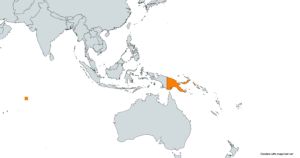
Eclectus parrots are native to rainforests. They usually live in the Solomon Islands, Indonesia, the Moluccas, and New Guinea. You can also find them in northeastern Australia. They prefer to build their nests high up in hollow trees.
Nests
Scientific Name
Evolution
For many years, scientists have wondered why the female Eclectus parrot is more colorful and striking than the male, unlike other birds and parrots. Males were first described in 1776, while females weren’t noted until 61 years later. They were long thought to be different species. Recently, scientists found out that the differences in appearance are linked to their breeding habits, which have adapted to limited nesting options.
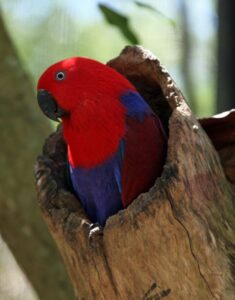
Eclectus parrots nest in tree holes that are at least 20 meters (65 ft) above the ground. These nesting sites are so rare that females have been known to fight to the death to protect them. Once a female establishes her nest, she stays there. Up to seven males will attend to her needs. They fly off to gather fresh fruit for her and her chicks. The males have developed green feathers that help them blend in with the fruit trees to hide from falcons and other birds of prey. The female, on the other hand, has bright red feathers to warn off other parrots and to blend in with her nesting site. Predators like falcons cannot see colors, but the parrots can and are able to recognize one another. This unique situation has led to the evolution of some of the most beautiful and interesting parrots in the world.
Appearance
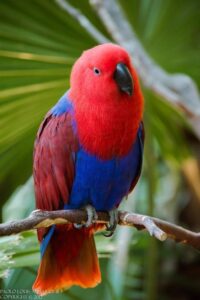
This medium-sized parrot is very colorful, but the males and females look quite different. In fact, they are so different in color that scientists once thought they belonged to two separate species. Still, their unique feathers make them very popular.
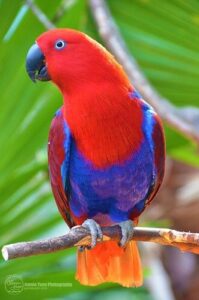
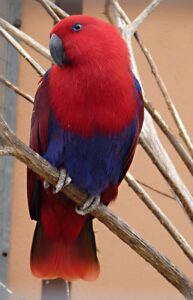
Males usually have bright green feathers with yellow near their heads. They display blue primaries and red beneath their wings. This blue color also appears closer to the tips of the feathers. Females are bright red, although the colors darken along their backs. Instead of red under their wings, they have purple on their mantle and underwing. The tips of their wings show a mix of mauve and blue, while their tails range from yellow to orange.
The wingspan of this parrot generally measures 8 to 10 inches, and their bodies are 12 to 14.5 inches long. An adult Eclectus parrot typically weighs around 16 ounces.
Behavior
Although they can carry a tune and imitate speech, their voice becomes clear only after they turn one year old.
Diet
Because of their long digestive tract, this parrot can easily eat foods that are high in fiber. They are herbivores, and their diet mainly consists of fruits, seeds, and plants. The female spends most of the year either with her chicks or protecting her nest, so she depends on her male partner or partners to bring back food by regurgitating it.